

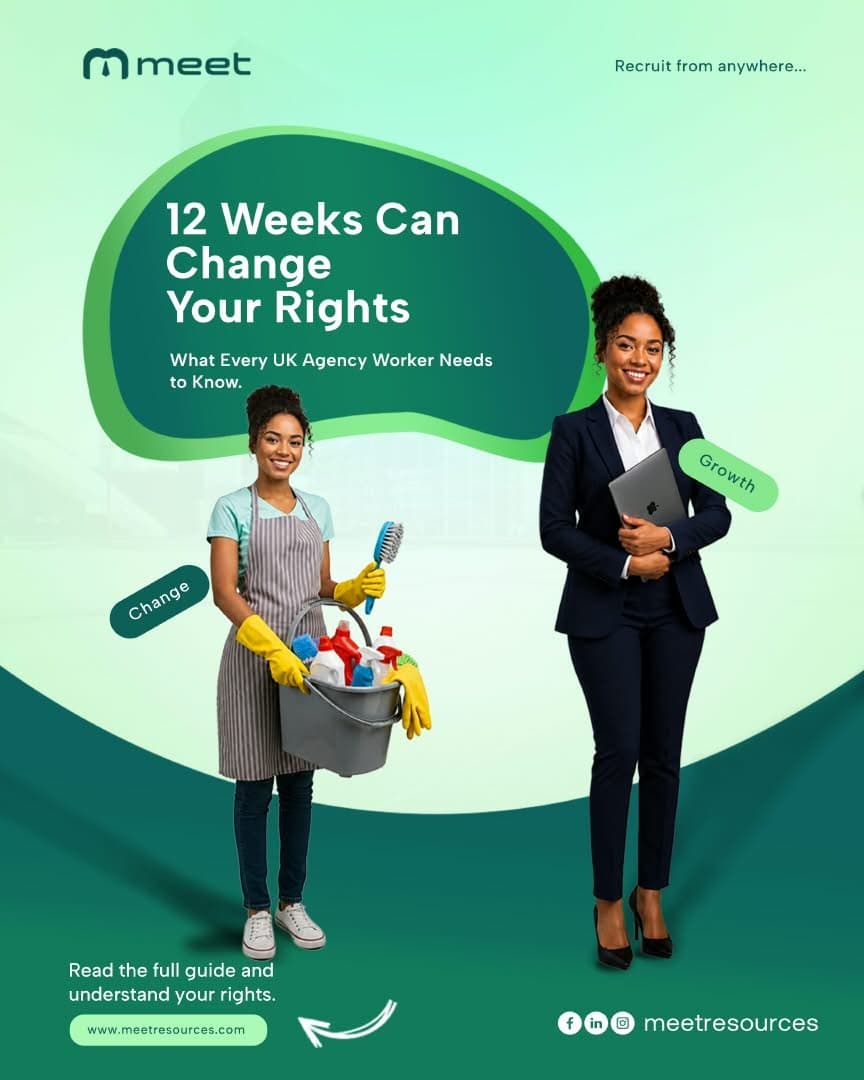
Imagine starting a temporary job on Monday.
You are doing the same work as permanent employees. You arrive at the same workplace, follow the same instructions, work the same shifts and contribute to the same business goals.
But there is one difference: you were supplied through a recruitment agency.
For many temporary workers, this can create uncertainty.
Am I entitled to the same pay? Do I get the same holidays? Can I use the same workplace facilities? What happens if I stay in the role for several months?
The UK's Agency Workers Regulations 2010 (AWR) provide important answers.
The regulations came into force on 1 October 2011 and established specific protections for agency workers. Most notably, after completing a 12-week qualifying period in the same job with the same hirer, an agency worker becomes entitled to equal treatment in certain basic working and employment conditions.
The AWR does not mean every temporary worker becomes a permanent employee. Instead, it establishes important rights designed to prevent agency workers from being unfairly disadvantaged simply because they work through an agency.
Here's what temporary workers, employers and recruitment agencies need to know.
Before the Agency Workers Regulations
Temporary employment has existed for decades, helping businesses cover staff shortages, seasonal demand, absences and busy periods.
For workers, agency employment has provided flexibility, income and opportunities to gain experience.
However, before the AWR came into force, there was no equivalent statutory framework providing agency workers with the specific equal-treatment protections that now apply after the qualifying period.
A permanent employee and an agency worker could perform similar jobs within the same organisation while having very different employment conditions.
The AWR introduced a clearer framework. Its central principle is simple: after 12 qualifying weeks in the same job with the same hirer, an agency worker is entitled to equal treatment in specified basic working and employment conditions.
Your Rights Start From Day One
One common misconception is that agency workers have no rights until they have completed 12 weeks. That's not true.
Agency workers have certain rights from the first day of their assignment. These include access to relevant collective facilities and amenities provided by the hirer, as well as information about relevant job vacancies within the organisation.
Workplace Facilities
If a company provides facilities such as a staff canteen, childcare facilities, transport or other shared workplace amenities, agency workers should generally have access to them on the same basis as comparable employees, subject to the applicable rules.
Being temporary should not automatically mean being excluded from the workplace environment.
Internal Job Vacancies
Agency workers should also have access to information about relevant vacancies within the organisation where comparable employees or workers would have access to that information.
This creates an important opportunity. A temporary assignment can potentially become a pathway to permanent employment. Someone who starts through an agency may discover a role within the organisation that fits their skills and career ambitions.
The 12-Week Rule
The most widely recognised aspect of the AWR is the 12-week rule.
When an agency worker completes 12 qualifying calendar weeks in the same job with the same hirer, they become entitled to equal treatment in specified basic working and employment conditions.
Importantly, the qualifying period is based on calendar weeks, not necessarily 12 weeks of full-time work. The government guidance explains that a week can count towards the qualifying period even where the worker only works for a short period during that week. This is particularly relevant to part-time and flexible workers.
What Does Equal Treatment Mean?
Equal treatment does not mean an agency worker automatically receives every benefit available to permanent employees. The AWR focuses on specified basic working and employment conditions. These include areas such as:
- Pay
- Working time
- Night work
- Rest periods
- Rest breaks
- Annual leave
After the qualifying period, the agency worker should receive the relevant basic terms that would have applied if they had been recruited directly by the hirer to the same job. For temporary workers, this can represent a significant improvement in their employment conditions.
Equal Pay Is a Major Protection
Pay is understandably one of the biggest concerns for agency workers.
After completing the 12-week qualifying period, an agency worker becomes entitled to the relevant basic pay they would have received if they had been recruited directly by the hirer for the same job, subject to the detailed rules around what constitutes pay. Depending on the circumstances, this can include basic salary and certain overtime, shift or unsocial-hours payments.
This is why communication between the hirer and recruitment agency is so important. The agency needs accurate information about the relevant terms and conditions applicable to comparable directly recruited workers.
Holiday and Working Time
The protection extends beyond pay.
After qualifying, agency workers can also be entitled to equivalent treatment regarding relevant working-time conditions, including rest breaks, rest periods, night work and annual leave.
This matters because employment conditions are about more than the amount appearing on a payslip. A worker's hours, rest periods and holiday entitlement can have a significant impact on their working experience.
What Happens If You Take a Break?
The 12-week qualifying period does not simply reset every time an agency worker takes a break.
The regulations contain specific rules covering different types of absence. Some breaks can pause the qualifying period, while others may cause it to restart. The rules can apply differently to circumstances such as sickness, annual leave, pregnancy-related absence and breaks between assignments.
This is why temporary workers should keep accurate records of their assignments, dates and periods away from work.
Changing Agencies Does Not Necessarily Reset the Clock
Here's another important point. Suppose you work for eight weeks at the same company through Agency A. You then move to Agency B but continue doing the same job for the same company.
Your qualifying period does not necessarily start from zero simply because you changed agencies. Government guidance confirms that an agency worker can qualify after 12 weeks in the same role with the same hirer even if they have been supplied by more than one temporary work agency during that period.
For workers, keeping a record of previous assignments can therefore be extremely useful.
What If Your Job Changes?
The 12-week rule relates to the same job with the same hirer. A genuinely different role can therefore affect the qualifying period.
However, simply changing a job title or making minor changes to duties does not automatically mean the clock resets. Factors such as skills, responsibilities, location, working hours, equipment, training and reporting arrangements may be relevant when determining whether a new role is genuinely different.
The regulations also contain anti-avoidance provisions intended to prevent arrangements being deliberately structured to prevent agency workers from obtaining their rights.
The End of the "Swedish Derogation"
Agency worker protections were strengthened further in 2020.
The Swedish derogation, sometimes known as the "pay between assignments" model, previously allowed certain agency workers to fall outside some equal-pay provisions if particular conditions were met. This exemption was abolished from 6 April 2020.
This means agencies can no longer rely on a permanent contract and payment between assignments to opt eligible agency workers out of equal-pay rights after the 12-week qualifying period.
What Employers Need to Know
The AWR is not only about protecting workers. Businesses that use temporary staff also have responsibilities.
Employers need to provide agencies with relevant information about the terms and conditions that apply to directly recruited workers. This may include information about:
- Pay
- Working hours
- Overtime
- Shift allowances
- Annual leave
- Other relevant employment conditions
Accurate information enables agencies to provide the correct treatment once an agency worker reaches the qualifying period.
Employers also have responsibilities regarding health and safety while agency workers are working on their premises. Using an agency does not mean outsourcing responsibility for the working environment.
What Recruitment Agencies Need to Do
For recruitment agencies, the AWR highlights the importance of accurate records and effective communication.
A professional agency needs to know:
- Who is the worker?
- Who is the hirer?
- What role are they performing?
- When did the assignment begin?
- Have they previously worked for the same hirer?
- How many qualifying weeks have they accumulated?
These details can directly affect a worker's statutory entitlements. Temporary staffing is therefore much more than matching a candidate with a vacancy. It involves compliance, record-keeping, communication and ongoing workforce management.
Where Meet Resources Comes In
At Meet Resources Limited, we believe temporary staffing should work for everyone.
Employers need flexibility. Workers need opportunities. Agencies need reliable processes. And everyone needs clarity.
The Agency Workers Regulations demonstrate why professional recruitment cannot stop once a candidate has been placed. A responsible staffing partner should understand the assignment, maintain appropriate records, communicate clearly with workers and employers, and support compliance throughout the employment relationship.
For temporary workers, that means greater confidence that their agency understands the rules. For employers, it means working with a staffing partner that understands the responsibilities involved in flexible workforce management.
Temporary Does Not Mean Second-Class
The AWR reflects an important change in the modern employment market.
Temporary work is no longer simply about filling a gap for a few days. Businesses use agency workers to manage changing demand, cover absences and access skills quickly. Workers use temporary employment to earn income, gain experience, develop skills and explore career opportunities.
Flexibility should not mean uncertainty about fundamental employment rights.
From Day One, agency workers have specific protections. After 12 qualifying weeks in the same job with the same hirer, additional protections can apply to specified areas including pay, working time, rest breaks and annual leave.
For employers, understanding these rules supports compliant workforce planning. For agencies, compliance is part of professional service delivery. And for workers, knowing your rights matters.
Because your job may be temporary. Your contribution is not.
This article is intended for general information and SEO purposes and does not constitute legal advice. Employment rights can depend on individual circumstances. For specific questions, workers and employers should seek advice from a qualified employment professional or an appropriate official advisory service.