

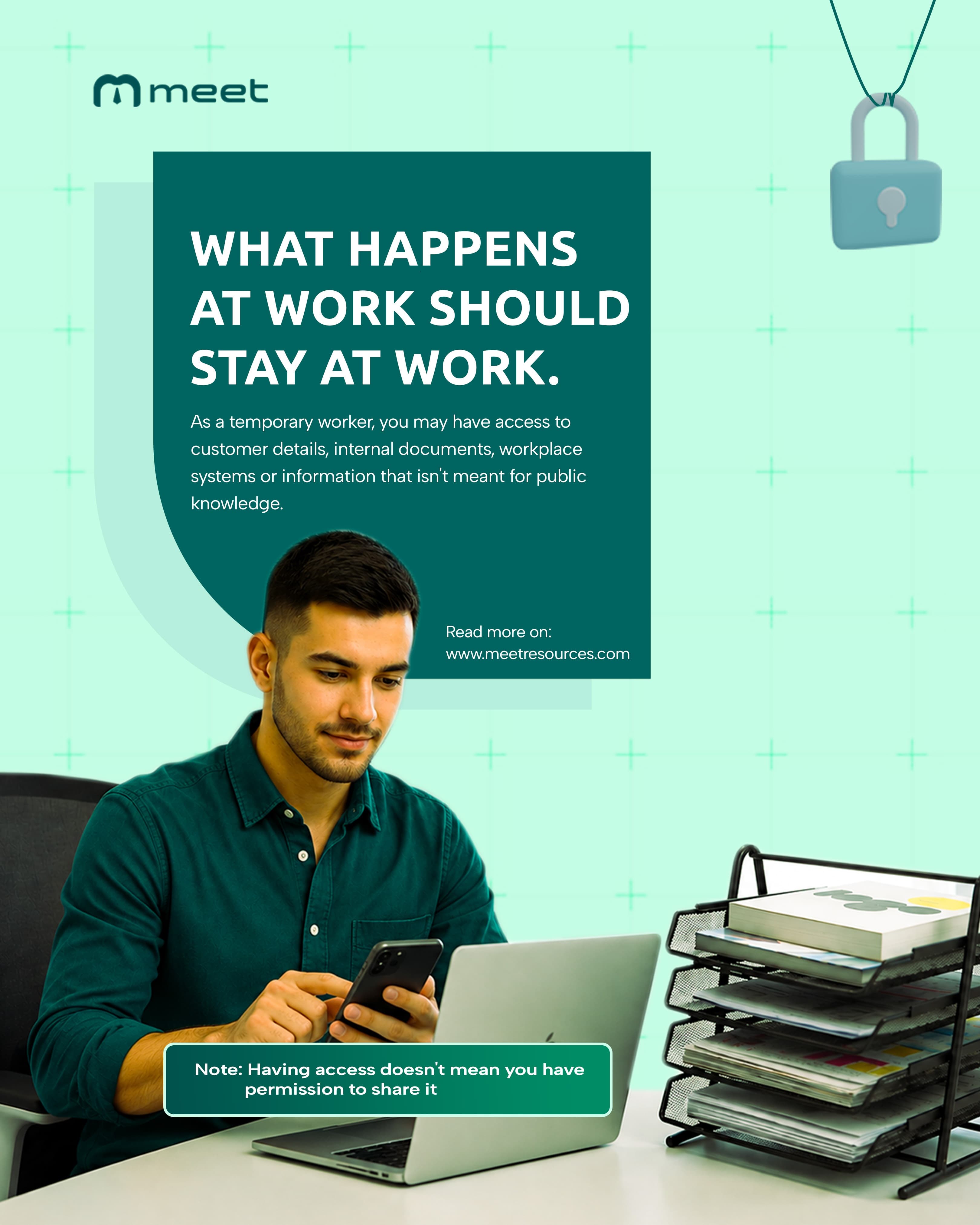
Temporary workers move between different workplaces, employers and assignments, sometimes gaining access to information that members of the public would never see. An agency worker supporting an office team might encounter employee records or internal correspondence. Someone working in healthcare or social care may come across personal information about patients or service users. A temporary worker in hospitality could learn about private events or customers, while someone working in logistics might have access to information about deliveries, stock levels or business operations.
Having access to information because your job requires it, however, does not mean you have permission to share it. For temporary workers, confidentiality is more than a clause buried inside an employment contract. It is part of professional conduct and can remain relevant even after an assignment has ended.
This is becoming increasingly important in a workplace where information can be copied, photographed, forwarded or posted online within seconds. A conversation that once stayed within a workplace can now become a social media post. A photograph taken casually during a shift can accidentally capture a computer screen or document in the background. What may appear harmless to the person sharing it could have serious consequences for the organisation or the individual whose information has been exposed.
Confidentiality is therefore not simply about keeping dramatic "secrets". It is about understanding that some information is entrusted to you because of your role and should only be used for the purpose for which it was provided.
Confidentiality Is Part of Professional Responsibility
When people hear the word confidentiality, they may immediately think of highly sensitive documents or information belonging to senior executives. In reality, confidential information can be much more ordinary. A temporary administrative worker might see an employee's salary information. A care worker might encounter information about a service user's health or personal circumstances. A warehouse worker might learn about upcoming deliveries or stock levels. A hospitality worker could become aware that a particular customer or organisation is holding a private event.
The fact that information appears ordinary does not necessarily mean that it is public.
The Information Commissioner's Office explains that organisations have responsibilities when processing personal data, including protecting it against unauthorised access, loss or disclosure (Information Commissioner's Office, 2025). Workers therefore have an important role to play in maintaining the confidentiality and security of information they encounter while performing their duties.
For an agency worker, the practical principle is straightforward: if information has been made available to you because you are carrying out your job, do not assume that you can use or share it for another purpose.
Access Does Not Mean Ownership
One of the most important distinctions for temporary workers to understand is the difference between having access to information and having ownership of that information.
A worker may be given access to an internal database because they need it to complete their duties. They may receive an email containing sensitive information because they are involved in a particular task. They may find documents on a desk because they are working in an office.
None of this automatically gives them permission to copy, photograph, forward, publish or discuss that information outside the legitimate requirements of their role.
The UK GDPR sets out several principles that organisations must follow when processing personal data, including purpose limitation, data minimisation, integrity and confidentiality (Information Commissioner's Office, 2025). These principles reinforce the importance of using information only in appropriate ways.
For temporary workers, this means asking a simple question before using information outside the immediate task: Do I actually need to use or share this information to do my job?
If the answer is no, it is usually better not to.
Think Before You Take a Photograph
Smartphones have made confidentiality more complicated.
Taking photographs at work may seem harmless. A worker might want to capture a team celebration, photograph a new workplace environment, or document something interesting that happened during a shift. But photographs can unintentionally capture information that should not leave the workplace.
A computer monitor might be visible in the background. A document may be lying on a desk. A whiteboard could contain names, telephone numbers, or operational information. A photograph of a workplace may reveal a customer's identity or location.
This is why workers should understand the employer's rules around photography before taking or publishing images from an assignment.
The same applies to screenshots. A screenshot of an internal message or workplace system may contain personal information even when the worker does not intend to expose it.
Before posting anything, consider what else the image might reveal.
Social Media Does Not Remove Professional Responsibilities
A personal social-media account does not automatically make workplace information yours to share.
A temporary worker might post about an unusual event during an assignment without naming the employer. However, the photograph, location, uniform, client reference or description of the situation may make the organisation or individuals identifiable.
Even apparently harmless comments can reveal more information than intended when combined with other details.
The safest approach is to understand the employer's social-media and confidentiality policies and follow them. If the workplace does not permit photographs or public discussion of certain matters, workers should respect those restrictions.
The fact that a post can be deleted later does not necessarily undo the consequences of sharing it in the first place. Screenshots and copies can exist long after the original post has disappeared.
Temporary workers should therefore treat social media as an extension of their professional responsibilities rather than a completely separate space.
What About Talking to Friends?
Confidentiality issues do not only happen online.
They can happen in ordinary conversations.
A worker may finish a shift and tell a friend about an unusual customer, a colleague's personal situation, an internal business decision, or something they overheard at work. The worker may have no intention of causing harm and may assume the conversation is private.
However, once confidential information is shared with someone who has no legitimate reason to know it, the worker may have compromised that confidentiality.
This is particularly important when the information concerns another person's personal circumstances.
A useful professional habit is to separate what is interesting from what is appropriate to share. Not everything that happens during a shift needs to become a story outside the workplace.
What If Someone Asks You for Information?
Temporary workers may sometimes find themselves in situations where someone outside the workplace asks questions about their assignment.
A friend may ask what a particular company is paying. Someone online may ask about a client. A former colleague may want information about an individual they know.
The worker may feel that answering is harmless, particularly if the information seems insignificant.
But if the information is confidential, the safest response is not necessarily to provide it.
If you are unsure whether something can be disclosed, ask your supervisor or agency contact. There is nothing unprofessional about saying that you are not able to discuss information from your workplace.
In fact, knowing when not to answer can be a sign of good professional judgement.
Be Careful With Passwords and Workplace Access
Confidentiality also extends to workplace systems and access credentials.
Some temporary workers may receive usernames, passwords, access codes or other information that allows them to use company systems. These credentials should be treated carefully and should not simply be shared with another person because they ask for them.
If a colleague needs access to a system, the appropriate response may be to direct them to the organisation's approved process for obtaining their own access.
This protects the organisation, but it also protects the worker. Activity carried out using an individual's credentials may be associated with that person's account, so allowing someone else to use them can create unnecessary risks.
What If You Accidentally See Something Confidential?
Not every confidentiality issue occurs because a worker deliberately goes looking for information.
A worker may open the wrong document. An email may arrive in their inbox by mistake. A message may appear on a shared screen. They may overhear a conversation that clearly was not intended for them.
Accidental access does not give a worker permission to keep, copy or share the information.
The sensible approach is to avoid unnecessary access and follow the organisation's procedures if the incident needs to be reported. Most importantly, do not take screenshots or photographs simply because something has appeared in front of you.
The professional response is to treat the information carefully and move on.
Does Confidentiality Continue After the Assignment?
One of the biggest misconceptions about temporary work is that responsibilities disappear when the assignment ends.
A worker may complete a two-week assignment and then move to another employer. That does not necessarily mean information learned during the previous assignment suddenly becomes public.
The exact legal obligations will depend on the circumstances, including the nature of the information, the worker's contract and applicable data-protection or confidentiality rules. However, workers should never assume that leaving an organisation gives them permission to disclose information they previously had a duty to protect.
This is particularly important when moving between employers.
Information learned while working for one organisation should not casually become part of conversations with another.
Confidentiality Can Be Different From Workplace to Workplace
Agency workers can move between sectors and employers, which means they may encounter very different confidentiality expectations.
A worker who spends several months in an office environment may become familiar with that employer's systems and procedures. Moving into a healthcare, social-care, education, or financial environment could introduce entirely different types of sensitive information and different policies.
Workers should therefore avoid assuming that because something was acceptable in one workplace, it will automatically be acceptable in another.
Every new assignment is an opportunity to understand the workplace's expectations.
Read the relevant policies. Pay attention during induction. Ask questions when something is unclear.
It is much easier to prevent a confidentiality problem than to repair one after information has been disclosed.
Confidentiality Protects People, Not Just Businesses
Confidentiality is sometimes presented as a way of protecting companies from reputational damage or commercial losses. While that is certainly one consideration, confidentiality also protects individuals.
A person's health information, financial details, contact information, family circumstances or employment records can be deeply personal.
When workers protect confidential information, they are protecting the people behind the information.
This is particularly important in sectors where temporary workers interact with vulnerable individuals or have access to sensitive personal records.
The principle is simple: people should be able to trust that information about them will be handled responsibly.
Workers Should Know What Is Expected of Them
Confidentiality should not be treated as a responsibility that workers are expected to understand automatically.
Employers should provide appropriate information about workplace policies and expectations, particularly where temporary workers will handle personal or commercially sensitive information. Agencies also have an important role in ensuring workers understand the requirements attached to their assignments.
Clear communication helps everyone.
A temporary worker should know what information they need to access, what they are expected to protect, which policies apply to them and who they should contact if they are unsure about something.
This is particularly important because temporary workers may enter workplaces they have never encountered before.
Where MEET Resources Comes In
At MEET Resources Limited, we believe professionalism goes beyond turning up for a shift and completing assigned duties.
It also means understanding the responsibilities that come with being trusted to work inside another organisation.
For employers, that means having confidence that temporary workers understand the expectations attached to their assignments. For workers, it means recognising that professionalism includes discretion, responsibility and respect for information.
Temporary work gives people access to different organisations, industries and professional environments. That access can create valuable opportunities, but it also comes with responsibility.
Being trusted with information is part of being trusted to work.
Final Thoughts
A temporary worker may not always know which piece of information will matter to someone else. That is why professional discretion is so important.
Think before photographing your workplace. Be careful about what appears in the background of a social-media post. Do not share passwords or access credentials. Avoid discussing confidential workplace information with people who have no legitimate reason to know it. And when you are unsure whether something can be shared, ask before sharing it.
Confidentiality is not about being secretive. It is about being responsible with information that has been entrusted to you.
References
- Information Commissioner's Office: A guide to the data protection principles
- Information Commissioner's Office: Information about workers' health
- business.gov.uk: Data protection in your business
This article is intended for general information, educational and SEO purposes and does not constitute legal or employment advice. Specific confidentiality obligations may vary depending on the worker's contract, assignment, workplace policies and the nature of the information involved.