

You apply for an agency role.
The position looks suitable. The hours work for you. The pay has been discussed. You are ready to start.
Then the agency asks for your identification, references or a DBS check.
For some temporary workers, this can feel like an unnecessary delay.
After all, if the employer needs someone quickly, why can't you just start?
The answer is that recruitment is not simply about finding someone who is available. In many roles, particularly those involving vulnerable people, children, healthcare, education, social care, finance or positions involving significant responsibility, employers need to establish that a candidate is suitable before allowing them to work.
For agency workers, this screening process can be particularly important because the worker may be placed into different organisations and environments through the same recruitment agency.
Understanding what background checks are, why they are carried out and what you can expect from the process can make temporary work much easier to navigate.
Screening Is Part of Recruitment, Not a Sign That Something Is Wrong
One of the first things an agency worker should understand is that being asked to complete checks does not necessarily mean the agency or employer suspects you of anything.
Background screening is a normal part of recruitment for many roles.
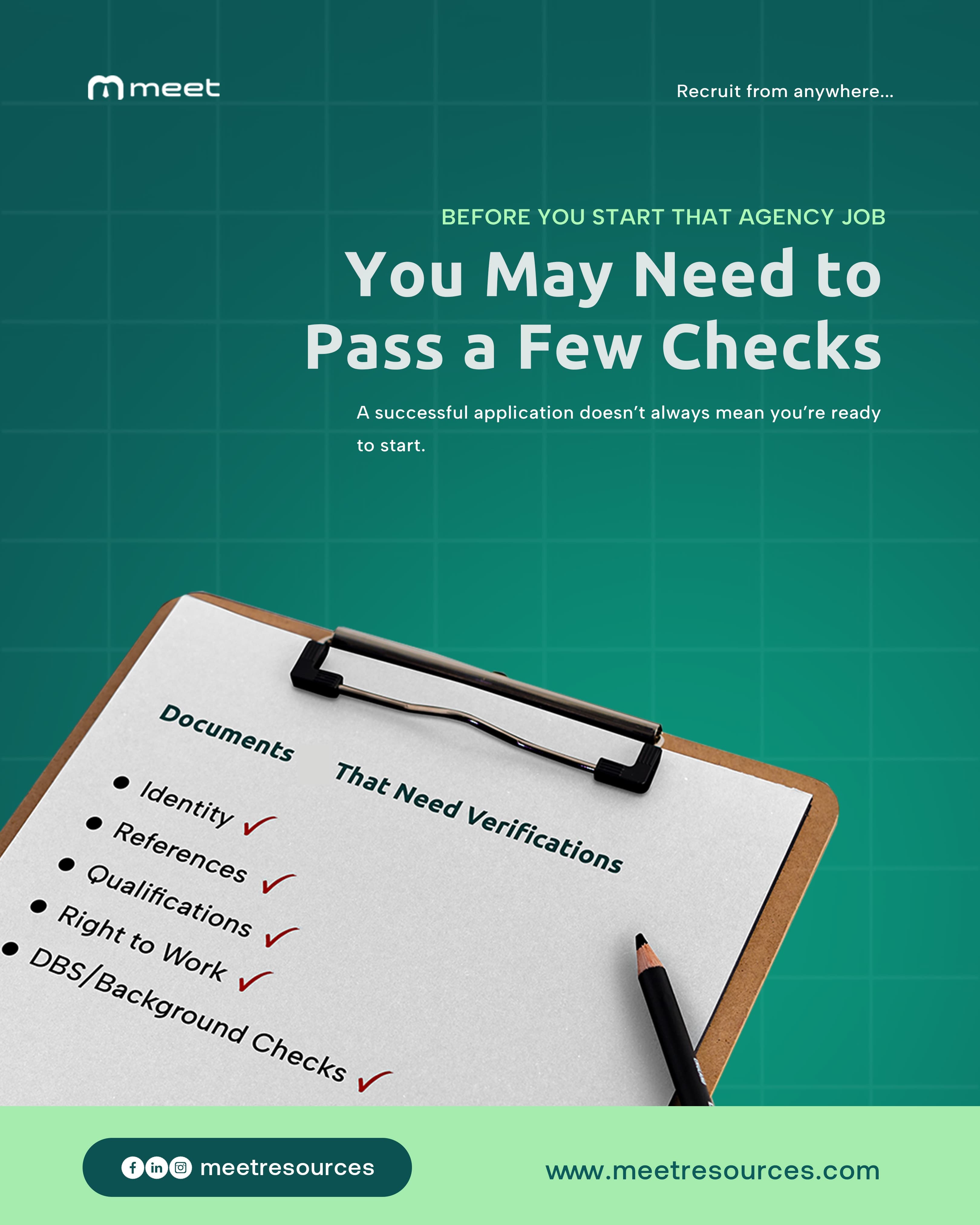
Depending on the job, an agency may need to verify your identity, employment history, qualifications, references, right to work and, where legally appropriate, criminal-record information.
The checks required will depend on the role.
A warehouse operative may require a different screening process from a support worker.
A hospitality worker may require different checks from someone working with children.
A healthcare role may involve more extensive requirements.
The important point is that there is no single background-check process for every agency worker.
What Is a DBS Check?
For workers in England and Wales, one of the most commonly discussed forms of screening is the Disclosure and Barring Service (DBS) check.
A DBS check helps employers make safer recruitment decisions by providing information about an individual's criminal record where the law allows that information to be disclosed.
There are different levels of DBS checks. These include:
- Basic DBS checks, which show unspent convictions and conditional cautions.
- Standard DBS checks, which can include spent and unspent convictions and cautions, reprimands and warnings, subject to the applicable rules.
- Enhanced DBS checks, which provide additional information where legally permitted and are used for eligible roles.
There is also an Enhanced DBS check with a check of the Children's or Adults' Barred Lists for eligible roles where the legal conditions are met.
The level of check is not something an employer can simply choose because it would be convenient. The role must be eligible for the relevant level of check.
That distinction matters.
Not Every Agency Worker Needs a DBS Check
This is an important misconception.
Working through an agency does not automatically mean you need a DBS check.
Whether a DBS check is appropriate depends on the role and the legal eligibility requirements.
For example, roles involving regulated activity with children or vulnerable adults may have specific eligibility requirements, while many ordinary jobs will not qualify for enhanced-level checks.
The official DBS guidance explains that employers should only request the level of check that is legally available for the particular role.
So if an agency asks you to complete a check, it is reasonable to understand what check is being requested and why the role requires it.
What Happens If You Have a Criminal Record?
This is an area where temporary workers can become unnecessarily anxious.
Having a criminal record does not automatically mean that you cannot work.
The relevance of previous convictions can depend on the role, the nature of the offence, how long ago it occurred and the applicable rehabilitation and disclosure rules.
Employers also have legal obligations concerning how criminal-record information is handled.
For certain roles, employers may need to consider whether a person is suitable based on information disclosed through the appropriate checking process.
The important thing for workers is not to assume that a past mistake automatically closes every employment opportunity.
If you are unsure about what you need to disclose, seek appropriate guidance rather than guessing.
References: Why Do Agencies Ask for Them?
References are another common part of recruitment screening.
An agency may ask for contact details for previous employers or other referees to help verify your employment history, experience or suitability for a particular role.
For some positions, references may be especially important.
Imagine an employer needs a worker with previous experience operating specific equipment.
Or a care provider needs someone with relevant experience working in a particular environment.
Or a client needs to verify that a candidate has genuinely held a particular qualification or position.
References can help establish that the information provided during recruitment is accurate.
For agency workers, this can also work in their favour.
A strong employment history can make it easier for an agency to understand your experience and match you with appropriate opportunities.
Be Honest About Your Experience
One of the biggest mistakes a temporary worker can make is exaggerating their experience because they want to secure an assignment.
It can be tempting to make a CV sound more impressive.
But if an agency or employer checks the information and discovers that the experience does not match what was claimed, the consequences can be much more serious than simply missing out on the role.
In some sectors, overstating qualifications or experience can create genuine safety risks.
If you have limited experience, say so. If you have transferable skills, explain them. If you are still learning, be honest about where you are in the process.
Credibility is an asset in temporary work.
Your Documents Matter
Background screening is much easier when your documents are accurate and consistent.
Before registering with an agency, make sure your CV, identification documents, qualifications and employment history contain consistent information.
Check dates. Check job titles. Check qualification names. Check spelling. Check contact details.
A small inconsistency does not necessarily mean there is a problem, but unexplained discrepancies can create delays while information is verified.
This is particularly relevant for workers who have changed roles frequently or have worked for several employers.
Keeping your own employment records can save time.
Why Screening Can Take Time
Temporary work is often associated with speed.
An employer needs five workers. The agency needs to fill the vacancies. The workers want to start.
But some checks cannot simply be rushed.
References may require responses from previous employers. Identity documents may need verification. DBS applications follow specific processes. Professional qualifications may need confirmation. For certain regulated roles, additional checks may be required.
That means there can be a difference between being available for work and being cleared to start a particular assignment.
Understanding this distinction can prevent frustration.
A delay does not necessarily mean the agency has forgotten about you.
Sometimes, the checks simply need to be completed properly.
Employers Have a Role Too
Background screening is not solely the worker's responsibility.
Employers and agencies also have obligations around recruitment and the handling of personal information.
The organisation requesting checks should understand what information it needs, why it needs it and how the relevant legal requirements apply.
This is especially important when dealing with sensitive personal information.
The Information Commissioner's Office provides guidance on employment practices and explains that organisations must process personal data lawfully, fairly and transparently.
For recruitment businesses, this means screening should be part of a structured process rather than an informal collection of personal documents.
Don't Send Sensitive Information Just Anywhere
Agency workers should also be careful about where they submit personal information.
Recruitment often requires sensitive documents, including identification and potentially criminal-record information.
Before sending documents, make sure you know who is requesting them, why they are required and how they will be used.
If someone contacts you unexpectedly through an unofficial channel requesting extensive personal information, pause and verify the request with the recruitment agency.
A legitimate recruitment process should provide clarity about what information is required.
What If Something on Your Record Is Wrong?
Errors can happen.
A reference might contain an incorrect employment date. A qualification might have been recorded incorrectly. A background check might contain information that you believe is inaccurate.
If you believe information being used in your recruitment process is incorrect, raise it promptly with the relevant organisation and ask how it can be reviewed or corrected.
Do not simply ignore an issue because you are worried that questioning it might cost you the job.
Accurate information benefits everyone.
Why This Matters Even More for Agency Workers
Temporary workers can move between organisations quickly.
One worker might complete an assignment in a warehouse and later move into another logistics role. Another might work across different care settings. A hospitality worker may work at several venues through the same agency.
A strong screening process creates a foundation for these placements.
Once the appropriate information has been properly verified, the agency can better understand where the worker may be suitable.
This is particularly valuable when the agency operates across multiple sectors.
The objective is not to create unnecessary barriers.
It is to create safer and more reliable matches between workers and employers.
What Should You Ask Your Agency?
If you are unsure about the screening process, don't be afraid to ask questions.
You can ask:
- What checks are required for this role?
- Why is this particular check required?
- Who will conduct the check?
- What documents do you need from me?
- How long is the process expected to take?
- Will I be able to start before the check is completed?
- What happens if there is an issue with the information returned?
These are reasonable recruitment questions.
A good agency should be able to explain its process clearly.
Where MEET Resources Comes In
At MEET Resources Limited, we understand that the quality of a placement begins before a worker arrives at the workplace.
Recruitment is not simply about finding someone who can fill a vacancy.
It is about understanding the role, identifying suitable candidates and completing the appropriate checks before making a placement.
For workers, that means a recruitment process designed around clarity.
For employers, it means greater confidence that candidates are being appropriately screened for the requirements of their roles.
And for everyone involved, it means building a staffing relationship based on trust, compliance and professionalism.
Because speed matters in recruitment.
But the right person, properly screened and appropriately matched, matters more.
Final Thoughts
If you are an agency worker, don't view screening as just another form to complete.
It is part of the process that connects you with the right opportunities.
Understand what checks are being requested. Provide accurate information. Keep your documents organised. Ask questions when something is unclear. And be patient when a legitimate verification process takes time.
For agencies and employers, the lesson is equally important.
A good recruitment process should balance speed with responsibility.
Businesses need workers quickly. Workers need opportunities. But neither should have to choose between efficiency and proper recruitment practices.
The best placement isn't simply the fastest one. It's the one where the right worker and the right employer are matched with confidence.
Checked. Verified. Ready for the right opportunity.
Sources and further reading
- GOV.UK: DBS checks: guidance for employers. Official guidance on Basic, Standard and Enhanced DBS checks and eligibility requirements.
- Information Commissioner's Office: Employment practices and data protection. Guidance on employers' responsibilities when processing workers' personal information.
- GOV.UK: Employment agencies and businesses. Official guidance covering the obligations of UK recruitment agencies and employment businesses.
This article is intended for general information and SEO/educational purposes and does not constitute legal advice. DBS requirements, employment rights and data-protection obligations can depend on the specific role and circumstances. Workers and employers with specific concerns should seek advice from the relevant official body or a qualified professional.