

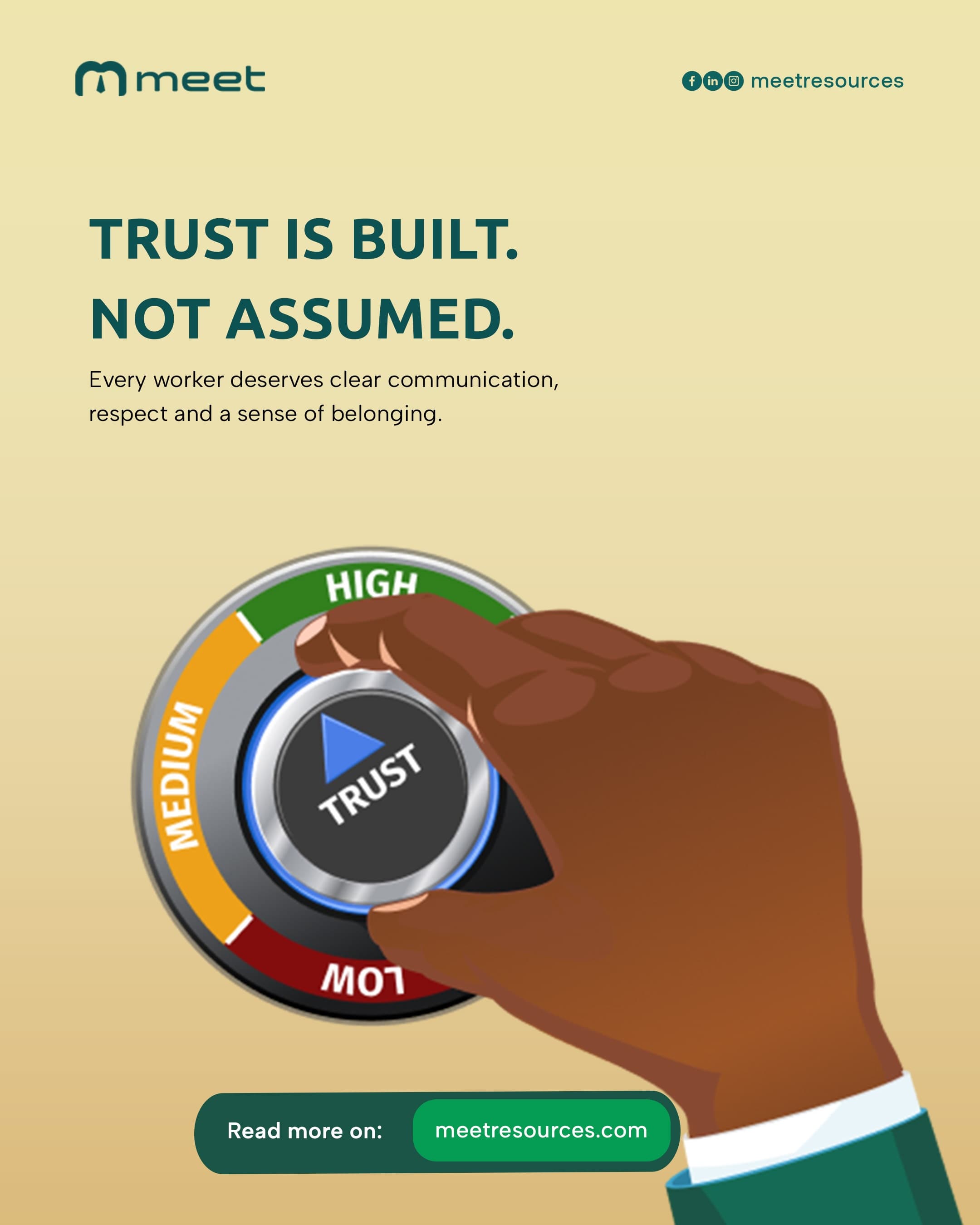
In staffing and recruitment, trust is often treated as something that comes naturally once an agency and a hirer begin working together. A vacancy is filled, a worker is placed, and both parties expect the relationship to run smoothly. Yet, as many staffing professionals know, a successful placement does not automatically create a trusting relationship.
Trust must be earned. It develops through honest communication, consistent actions, clear expectations and respect for the responsibilities of everyone involved.
The relationship between a staffing agency, an agency worker and a hirer is built on shared expectations:
- The agency is expected to understand the vacancy and identify suitable candidates.
- The worker expects accurate information about the assignment and fair, professional treatment.
- The hirer expects the agency to provide workers who meet the role's requirements and to communicate effectively throughout the process.
When these expectations are handled carelessly, confidence can quickly diminish. When they are managed with transparency and mutual respect, the relationship has a stronger foundation for success.
For modern staffing agencies, the challenge is therefore not simply to fill vacancies. It is to build relationships in which trust is demonstrated through everyday professional conduct.
1. Trust Begins With Transparency, Not Promises
A staffing relationship can become strained when one party makes commitments that the others cannot rely on.
An agency might promise a hirer that a candidate is ready to start without fully confirming the worker's availability. A worker might receive incomplete information about shift patterns, responsibilities, location or assignment requirements. A hirer might assume that the agency understands the operational demands of a role without providing a sufficiently detailed brief.
These situations can create avoidable misunderstandings before the placement has even begun. (Our guide to preparing a placement before day one looks at this stage in more detail.)
Transparency means communicating what is known, clarifying what remains uncertain and avoiding promises that cannot reasonably be guaranteed. It also means giving workers and hirers the information they need to make informed decisions.
GOV.UK guidance on the information agencies must obtain before placing a worker with a hirer highlights the importance of gathering relevant information about a vacancy before making a placement.
This is not merely an administrative exercise. Accurate information supports better decisions and helps establish realistic expectations among the parties involved.
Trust grows when people discover that the information they receive is reliable and that commitments are treated seriously.
2. Mutual Respect Means Recognising Every Party's Contribution
Agency work involves different interests and responsibilities, but no party should be treated as though its contribution does not matter.
Staffing agencies operate under commercial and operational pressures. Hirers need workers who can support their service delivery and meet the demands of their business. Agency workers need clear information, professional treatment and an understanding of what is expected of them.
Problems arise when one party's priorities consistently overshadow the others.
For example, an agency that focuses exclusively on meeting a hirer's deadline may overlook whether a worker has received sufficient information about the assignment. A hirer that treats agency workers as interchangeable resources may fail to recognise the importance of induction, communication and workplace support. Equally, an agency that does not take a hirer's operational requirements seriously can undermine the confidence needed for a productive partnership.
Mutual respect does not mean that all parties have identical responsibilities. It means recognising that each party has legitimate expectations and that these should be handled professionally.
Acas guidance on agency workers provides useful information about agency work and the rights and responsibilities relevant to these arrangements.
Respect becomes visible through practical actions: responding to enquiries, sharing accurate information, addressing concerns professionally and avoiding communication that dismisses another party's legitimate needs.
A relationship becomes more dependable when everyone involved understands that professionalism is a shared responsibility.
3. Accountability Is What Makes Trust Sustainable
Good working relationships are not defined by the absence of mistakes. They are defined, in part, by how people respond when things go wrong.
A worker may arrive for an assignment only to discover that the shift details have changed. A hirer may identify a mismatch between the agreed requirements and the worker's actual duties. An agency may receive conflicting information about a placement.
In each situation, the response matters.
Blaming another party, withholding information or ignoring a concern can turn a manageable problem into a lasting breakdown in confidence. A more constructive response involves establishing what happened, communicating the facts, clarifying responsibilities and agreeing on the next steps.
Accountability also means recognising the limits of each party's role. Staffing agencies, workers and hirers do not have identical duties, and their responsibilities should not be confused or transferred casually from one party to another. (See Who Is Responsible for What?)
For workplace health and safety, the Health and Safety Executive's guidance explains the roles of suppliers, such as employment businesses, and of the end-user businesses working with agency and temporary workers. Understanding these respective responsibilities helps the parties approach safety as a shared concern while recognising their distinct obligations.
A staffing agency strengthens trust when it takes concerns seriously, communicates honestly about problems and follows through on agreed actions. Hirers and workers contribute by raising issues appropriately and providing accurate information.
Accountability is not about finding someone to blame. It is about ensuring that commitments, responsibilities and corrective actions are taken seriously.
4. Communication Should Not Depend on Who Has the Most Power
In any professional relationship, differences in commercial influence or decision-making authority can affect how people communicate. In agency work, the hirer may control access to assignments, the agency may manage the recruitment relationship, and the worker may depend on clear information to perform the role successfully.
These differences make respectful communication particularly important.
A worker who feels unable to ask questions may begin an assignment without understanding important requirements. An agency that is reluctant to challenge unclear instructions may proceed with assumptions that later cause difficulties. A hirer that receives incomplete updates may be left unprepared for operational changes. (See The Hidden Cost of Poor Agency-Hirer Communication.)
Professional communication should not depend on which party has the greatest influence in the relationship.
Each party has a part to play:
- Agencies can set clear expectations at the beginning of an assignment, explain the appropriate channels for questions and concerns, and ensure that important updates reach the relevant people.
- Hirers can provide clear instructions and respond constructively when issues are raised.
- Workers should receive appropriate information about their assignments and know whom to contact when clarification is needed.
GOV.UK's overview of the Conduct Regulations 2003 offers further context on the regulatory framework for employment agencies and employment businesses.
Respectful communication is not simply about being polite. It is about creating the conditions in which relevant information can be shared, concerns can be addressed and decisions can be made with a clearer understanding of the situation.
5. Trust Must Be Demonstrated in Everyday Decisions
Organisations often describe themselves as reliable, transparent or people-focused. However, these qualities become meaningful only when they are reflected in actual behaviour.
Consider a staffing agency that receives an urgent request from a hirer. The pressure to fill the vacancy quickly may be significant, but the agency still needs to establish the role's requirements, communicate relevant information and avoid presenting an unsuitable candidate simply to meet a deadline. (See The Right Worker Can Still Be the Wrong Match.)
Similarly, a hirer that expects professionalism from an agency should provide accurate information about the assignment, clarify operational requirements and communicate material changes promptly. A worker who commits to an assignment should also communicate availability or changes that may affect attendance.
Each decision sends a message about whether the relationship can be trusted.
The CIPD's recruitment factsheet provides further insight into recruitment practice and the importance of effective processes when bringing people into organisations.
For staffing agencies, the lesson is straightforward: trust is not established by saying the right things during an introductory meeting. It is strengthened when the same professional standards are maintained under pressure, during difficult conversations and when circumstances change.
Consistency matters because professional relationships are often judged by how people behave when the situation becomes inconvenient.
6. Mutual Respect Is a Business Advantage
Mutual respect is sometimes dismissed as a soft value that sits outside commercial performance. In reality, the way agencies, workers and hirers treat one another can influence the quality and stability of their working relationships.
Where communication is poor, expectations are unclear or concerns are repeatedly dismissed, parties may spend more time resolving misunderstandings than addressing the work itself. Confidence can weaken, cooperation can become more difficult, and future engagements may be affected.
By contrast, professional relationships built on transparency and accountability give parties a clearer basis for working together. Problems can be raised earlier, expectations can be clarified, and decisions can be made with greater confidence in the information being shared.
Mutual respect does not eliminate disagreements. Agencies and hirers will sometimes have different priorities, and workers may raise concerns that require careful consideration. The objective is not to avoid every difficult conversation but to handle those conversations fairly and professionally.
This is especially important in temporary and agency work, where assignments may change quickly and several parties must coordinate their efforts.
For agencies, building trust means looking beyond the immediate transaction. It means recognising that every placement contributes to a wider professional relationship, and that the quality of that relationship depends on the conduct of everyone involved. (See What Happens After the Placement?)
Conclusion: Trust Is Earned Through Action
A placement may begin with a vacancy, a recruitment brief and an agreed start date. But the strength of the relationship behind that placement depends on what happens throughout the working arrangement.
Are expectations communicated clearly? Is relevant information shared honestly? Are workers treated with dignity? Are responsibilities understood? Are concerns addressed constructively? Do agencies and hirers follow through on their commitments?
These are the everyday questions that reveal whether trust is being built or merely assumed.
For staffing agencies, workers and hirers, the way forward is not complicated, although it requires consistent effort: communicate transparently, respect each other's contributions, take responsibility for your part and treat professional commitments seriously.
Because trust is built, not assumed. And stronger agency relationships begin when mutual respect becomes a practice, not just a promise.