

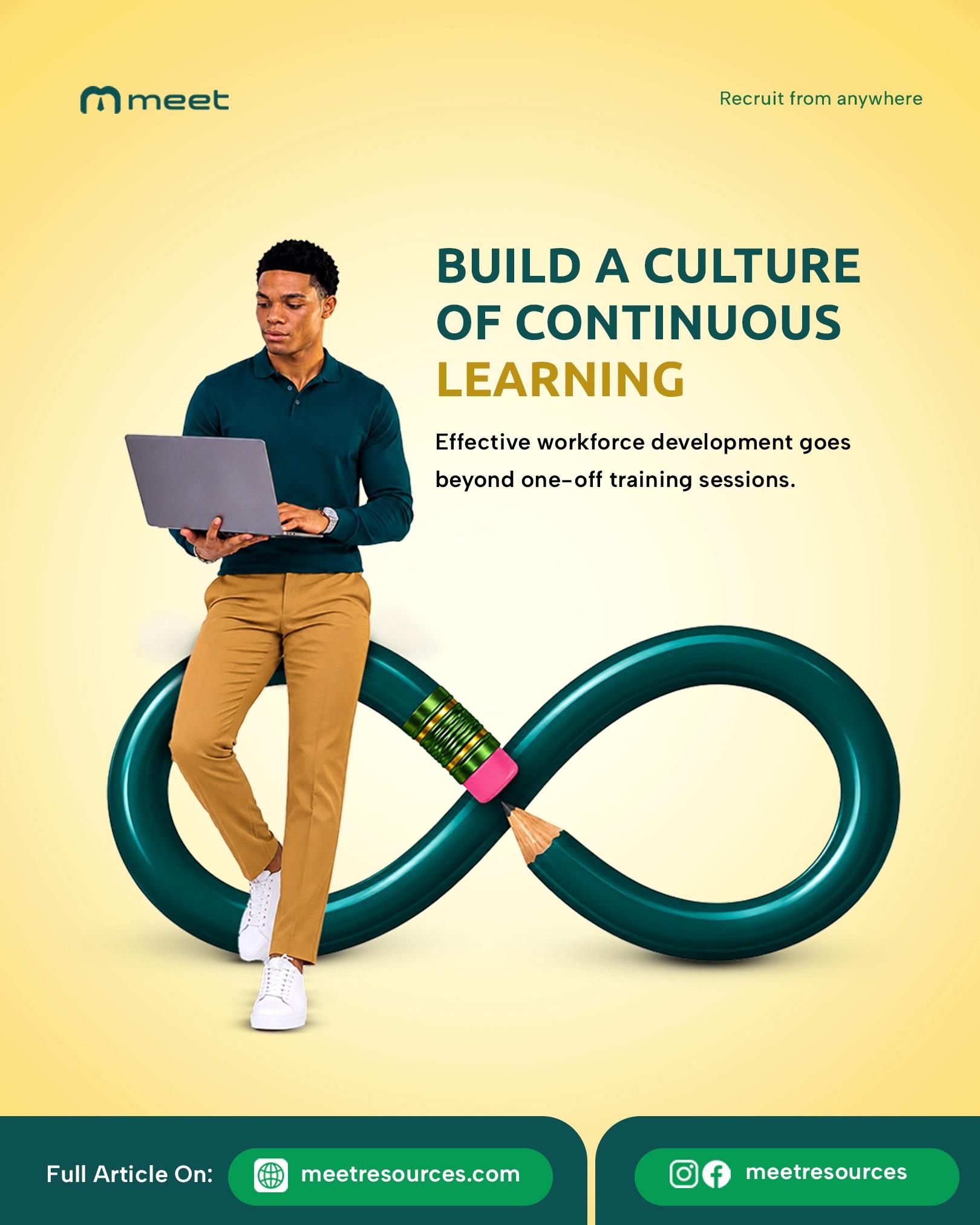
In staffing and recruitment, placing the right worker in the right assignment is only part of workforce development. Workers also need opportunities to maintain their skills, keep up with changing workplace expectations and build the capabilities to perform well across different assignments. Yet in many staffing environments, learning still happens mainly at the start of an assignment, during induction or when a compliance requirement has to be met.
A culture of continuous learning takes a different approach. It treats workforce development as an ongoing process built into how staffing agencies recruit, prepare, support and engage workers. Rather than waiting for a performance concern or a hirer's complaint before offering more training, agencies create regular opportunities for workers to learn, receive feedback and strengthen their skills throughout their working journey.
The CIPD's guide to learning and development sets out the key steps to effective learning: creating a learning strategy, identifying learning needs, designing suitable interventions and measuring their impact. Staffing agencies can adapt these principles to build a workforce that is ready for its current assignment and better prepared for future ones.
Building a learning culture does not require a large training budget or a dedicated learning and development team. It starts with a commitment to making learning relevant, accessible and valuable to workers, and to making sure the skills being developed reflect the needs of the assignments agencies support.
1. Treat induction as the start, not the only learning opportunity
Induction is an essential part of preparing workers for an assignment. It introduces workplace expectations, procedures, responsibilities and key safety information. But it should be the starting point of workforce development, not the final stage.
Agency workers may move between different hirers and working environments, each with its own procedures, equipment and expectations. A worker who completed an induction for one assignment may need further preparation before starting another. Even within the same assignment, new equipment, technology or responsibilities can create new learning needs, as we explore in The Assignment Changed: Did Your Temporary Workers Know?
The Health and Safety Executive's guidance on the roles of suppliers and end-user businesses explains that labour suppliers should liaise with the business using the worker before work begins, to understand the duties, skills, experience, qualifications and workplace risks involved. It also stresses communication and cooperation throughout the assignment.
That gives agencies a practical foundation for continuous learning. Assignment changes, worker feedback and information from hirers all signal when extra instruction or refresher learning may be needed. Instead of assuming that past training prepares a worker for every future assignment, agencies can make learning part of the ongoing placement process.
2. Make learning relevant to workers' real assignments
Workers engage more with learning when they can see how it relates to their work. Generic training provides useful background, but it cannot always address the specific challenges of different roles.
An agency supplying warehouse workers may find recurring learning needs around manual handling, equipment use, stock management or workplace communication. An agency supplying administrative staff may find that digital systems, data handling and customer service are higher priorities.
The CIPD's factsheet on methods of delivering learning interventions looks at the factors to weigh when choosing how to deliver learning, the range of methods available and the value of blended approaches.
For agencies, that means matching the learning to the assignment rather than using one training format for every worker. Short digital modules, practical demonstrations, coaching, workplace briefings and supervised learning can all play a part when chosen to fit the learning objective.
A worker learning a new digital system may benefit from a short online demonstration followed by guided practice. A worker taking on a safety-critical task may need practical instruction and assessment before being allowed to do it. What matters is whether the method helps the worker develop, and demonstrate, the capability required. As we explain in Completion Is Not Competence, finishing a course is not the same as being able to do the job.
3. Spot skills gaps before they become performance problems
A learning culture encourages agencies to identify development needs early. That means reviewing the skills assignments require, understanding workers' existing capabilities and recognising where extra support is needed.
The government's Employer Skills Survey 2024 found that 12% of UK employers had at least one member of staff who was not fully proficient in their role. In total, 1.26 million employees, about 4% of the workforce, were judged by their employers to have a skills gap. These findings cover the wider UK workforce rather than agency workers specifically, but they show why identifying and addressing capability gaps matters.
Agencies can draw on recruitment assessments, training records, conversations with workers and hirer feedback to see where development is needed. If several workers in similar roles struggle with the same system, for example, that points to a wider learning need that targeted training could address. Our guide to using training data to close skills gaps explains how to spot these patterns.
Identifying learning needs before designing training, as the CIPD recommends, helps organisations avoid delivering training simply because it is available, and focus instead on the capabilities workers and hirers genuinely need.
Catching skills gaps early lets agencies offer more relevant support, prepare workers better for assignments and help them build skills that strengthen their future employability.
4. Encourage workers to take ownership of their development
A continuous learning culture should not depend entirely on training delivered by the agency. Workers should be encouraged to take an active interest in their own development and to see learning as part of their professional growth.
That does not mean handing the whole responsibility for training to workers. Agencies still need to provide suitable opportunities, clear information and support. But workers can be encouraged to identify skills they want to strengthen, ask questions about unfamiliar tasks, seek feedback and take part in relevant learning.
A worker who regularly takes customer-facing assignments might want to develop communication, conflict management or digital customer service skills. The agency can support this by signposting learning resources, sharing opportunities and explaining which capabilities could open up future assignments. Our articles on why CPD matters for temporary workers and why professional development doesn't stop when you get the job cover the worker's side of this.
Learning should also be recognised. When workers complete relevant development or show improved skills, agencies can acknowledge their progress and consider how those new capabilities support future placements.
The CIPD's factsheet on learning evaluation, impact and transfer highlights the importance of checking whether learning is applied at work. Encouraging workers to reflect on how they use new knowledge helps connect training with real development.
5. Build learning into everyday communication
A learning culture lasts longer when learning is not confined to formal training sessions. Everyday conversations between workers, recruitment consultants, compliance teams and hirers are valuable development opportunities in their own right.
Regular check-ins help agencies understand how workers are settling into assignments, whether they have met unfamiliar tasks and whether extra support would help. They can also reveal changes in assignment requirements that affect future training needs. Our article on what happens after the placement explains why that follow-up matters.
Hirers can contribute by giving constructive feedback on workers' performance and flagging changes to procedures or expectations. Agencies can use this to identify common learning needs and arrange support.
The HSE's guidance stresses that clear communication and cooperation between suppliers and end-user businesses are central to protecting agency and temporary workers. The same collaborative approach helps agencies and hirers stay clear about the learning and preparation workers need throughout an assignment.
A short conversation soon after an assignment begins can reveal a training need that would otherwise go unnoticed. Over time, these conversations become a valuable part of workforce development.
6. Use technology to make learning accessible and manageable
Technology helps agencies reach workers spread across different locations, assignments and schedules. A learning management system (LMS) can organise learning materials, track completion, deliver assessments and help agencies keep on top of refresher requirements.
Digital learning is especially useful for short modules workers can complete around their assignments, and for giving every worker consistent information before an assignment starts.
But technology should support learning, not become the learning strategy itself. Different approaches suit different skills and contexts, and digital learning should be supplemented with practical instruction where needed. Agencies should also check that workers have access to suitable devices, reliable internet and learning formats that work for them. Our guide to making training accessible to a diverse agency workforce covers this in detail.
Training records must be handled responsibly. The Information Commissioner's Office guidance on collecting and keeping employment records lists training records among the personal information organisations keep about workers, and explains that it must be handled fairly, lawfully and transparently. Agencies should collect only relevant information, explain how it will be used and put appropriate access and retention arrangements in place. For more, see our guide to data protection and temporary worker records.
7. Measure progress and keep improving
A learning culture should be judged by more than the number of courses completed. Agencies need to know whether learning is helping workers develop relevant skills and perform more effectively.
Useful indicators include participation in learning, assessment results, worker feedback, practical observations and hirer feedback. Agencies can also track whether recurring capability concerns are falling and whether workers are becoming better prepared for particular types of assignment.
The CIPD's guidance on learning evaluation recommends linking evaluation to learning objectives and performance needs. In practice, that means deciding what a programme should achieve before delivering it, then checking whether it did.
Evaluation should also improve the learning process itself. If workers are not engaging with a module, it may be too long, hard to access or not relevant enough. If workers complete training but still struggle, they may need practical support, clearer instructions or a different approach.
Continuous improvement lets agencies act on these findings and make each round of learning more relevant than the last.
Make learning part of the workforce journey
Building a culture of continuous learning means moving beyond training as a one-off activity. It involves creating an environment where workers can develop their skills, receive feedback, access relevant learning and prepare for changing assignment requirements.
Agencies can start by reviewing their current training processes, identifying recurring skills gaps, engaging workers and hirers, and introducing practical learning that reflects real workplace needs. Feedback and evaluation then help improve the approach over time. For a closer look at why this matters, read the role of continuous learning in improving workforce readiness.
A learning culture does not need to be complicated. It needs to be consistent, relevant and supported by good communication between everyone involved in staffing and assignment delivery.
At Meet Resources, we believe workforce development should continue well beyond the first day of an assignment. By making learning an ongoing part of the staffing process, agencies help workers build the confidence, knowledge and capabilities they need to succeed. The strongest workforce is not simply the one that has been trained. It is the one that keeps learning.
Explore how Meet Resources supports agencies and hirers, and read more about keeping workforce training up to date.
This article provides general information, not legal advice. Organisations should check the requirements that apply to their roles, workplaces and jurisdiction.
References and Further Reading
- CIPD: Learning and development guide
- CIPD: Methods of delivering learning interventions
- CIPD: Learning evaluation, impact and transfer
- UK Government: Employer Skills Survey 2024
- Health and Safety Executive: Roles of suppliers and end-user businesses
- Information Commissioner's Office: Collecting and keeping employment records